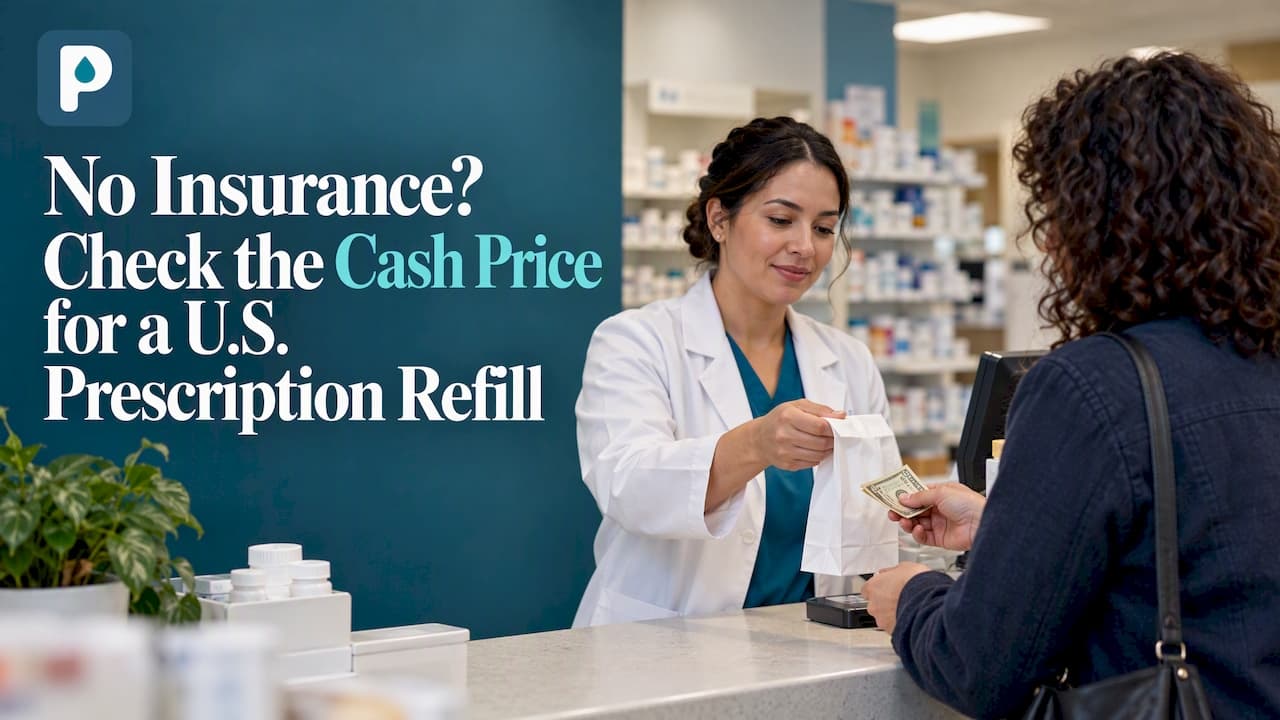
Yes, you can refill a prescription without insurance, and the fastest first move is asking your pharmacist for the cash price on a generic. From there, your main routes are pharmacy low-cost generic programs, manufacturer assistance, community health centers, mail-order pharmacies, and telehealth refill requests. We offer clinician-reviewed refills online for patients who want a direct, no-insurance path.
TL;DR:
- Generic prices can fall by 80% or more once several competitors enter; confirm the strength and quantity, then compare prices at two or three pharmacies.
- For costly brand or specialty drugs without generics, manufacturer assistance may help, but applications need income proof and prescriber input; ask about a bridge supply.
- Community health centers may offer discounted formulary drugs, but eligibility and stock limit access; call ahead with income documents and schedule before you run out.
- Mail order may lower costs on a 90 day supply of maintenance drugs, but prices vary by medication and shipping rules out urgent fills.
- For stable, noncontrolled prescriptions, telehealth offers a refill review, not a lower drug price; Plunge charges $39.99 per visit only if a clinician accepts.
Table of Contents
- Which prescription refill route fits your situation?
- How do low-cost generic programs work?
- How do manufacturer patient assistance programs work?
- Can community health centers and 340B clinics lower your costs?
- Are direct-to-consumer and mail-order pharmacies cheaper?
- How do telehealth refill services work without insurance?
- What can you do at any pharmacy to pay less?
- How long does each option take and what does it cost?
- Our view on refills for uninsured patients
- Start a refill request with us
- FAQ
- Sources
Which prescription refill route fits your situation?
Not every option suits every medication or every deadline. Start with what you need most: speed, a lower monthly price, or help with an expensive drug.
- Same-day fill of a common drug: Ask a chain pharmacy for its cash price and whether the drug is on its low-cost generic list. This is usually the quickest path when you are down to your last few pills.
- Ongoing chronic medication where cost is the barrier: Check a community health center or 340B-eligible clinic, which often supplies medications at deep discounts through a limited formulary.
- Expensive brand or specialty drugs: Look at the manufacturer's patient assistance program, which can supply the medication free or at low cost when you meet income rules.
- Convenience and clinician review: A telehealth refill request can avoid an office visit and insurance paperwork when your condition is stable and the drug is not a controlled substance.
- Medicare enrollment or eligibility: If you have Medicare or are close to qualifying, look at the Extra Help program before anything else, because it can shrink drug costs for good.
Many people combine routes. You might use a pharmacy's generic program for a blood pressure pill, a manufacturer program for an inhaler, and telehealth for the renewal that keeps both prescriptions active. The sections below walk through each one so you can pick quickly and act today.
How do low-cost generic programs work?
Generic competition is the biggest reason some prescriptions are cheap. The FDA reports that generics account for about 90% of U.S. prescriptions while making up roughly 20% of total drug spending, and prices can fall by 80% or more once several generics reach the market. That gap is the savings you are trying to capture.
Many national and regional pharmacies run their own low-cost generic lists, with a flat price for a 30-day or 90-day supply of common drugs. Programs change, and not every drug or strength is included, so you have to ask rather than assume. A pharmacist can tell you whether your medication is on the list.
Federal statistics point the same way. The FDA's annual generic drug program overview notes that a high share of generic prescriptions are filled for $20 or less.
Here is how to put this to work:
- Get the exact drug name, strength, and form from your current bottle or your prescriber.
- Ask your prescriber to write for the generic and to allow substitution when it is clinically appropriate.
- Ask the pharmacist whether the drug is on a low-cost generic list and what the cash price is without any card.
- Compare the same strength and quantity at two or three pharmacies, since a 30-tablet fill and a 90-tablet fill are priced differently.
Pro Tip: Say "I'm paying cash, what is your lowest price on the generic?" Cash customers are sometimes quoted a list price first, and that question prompts the pharmacist to check programs and discounts.
If your drug has no generic, that is the moment to move to manufacturer assistance, covered next.
How do manufacturer patient assistance programs work?
Patient assistance programs, often called PAPs, are run by drug makers and some nonprofits to supply medication free or at low cost to people who cannot afford it. They matter most for expensive brand or specialty drugs where no generic exists and the cash price is out of reach.
The payoff can be large. A program evaluation of clinical pharmacists helping patients enroll in medication assistance programs reported average savings above $10,000 per patient in selected cohorts. Your results will depend on the drug and the program, and approval is never certain.
Most programs ask for similar things, so you can prepare once and reuse the paperwork:
- Find the manufacturer's program by searching the drug's brand name plus "patient assistance program."
- Download the application and read the eligibility rules, which usually involve household income, household size, and sometimes U.S. residency.
- Gather proof of income, such as a recent tax return or pay stubs.
- Ask your prescriber to complete and sign their section, which typically includes the prescription itself.
- Choose where the medication ships, either to your home or to your prescriber's office, and submit everything together.
- Follow up by phone if you have not heard back within the stated processing window.
A few habits raise your odds. Keep copies of everything you send. Ask your prescriber's office whether a clinic pharmacist or social worker handles these forms, because staff who file them regularly know which fields trip people up. If you have a specific condition, ask whether a disease-focused nonprofit offers grants for that diagnosis, since those can cover costs a manufacturer program does not.
Plan for a gap. Applications take time, so ask your prescriber about samples or a short bridge supply while you wait.
Can community health centers and 340B clinics lower your costs?
Community health centers and 340B-eligible clinics are among the most underused routes for uninsured patients. Many offer sliding-scale visits and medications at reduced prices, usually from a limited in-house formulary.

A study of a retail pharmacy assistance program inside a 340B-eligible health system found it dispensed many prescriptions free of charge or at deep discounts to eligible outpatients. The same evaluation showed the limits: the benefit depended on formulary coverage and on meeting the program's eligibility rules.
Getting started is straightforward:
- Search for a federally qualified health center near you through the health center locator on the federal HRSA website.
- Call ahead and ask what documents to bring. Common requests are photo ID, proof of address, and proof of income such as pay stubs or a tax return.
- Ask whether the clinic has its own pharmacy or contracts with a nearby one, and how the sliding fee is calculated.
- Bring your medication list and ask staff whether your drug is on the formulary. If it is not, ask which similar drug is, and discuss the swap with the clinician.
Timing helps. Schedule your visit before you run out, since the clinician must see you or review your record before writing a new prescription. For in-stock formulary drugs, many clinics can fill the same day, which makes this a strong option when a refill is due soon and a regular pharmacy price is too high.
Are direct-to-consumer and mail-order pharmacies cheaper?
Often, but not always, and that is why comparing matters. Direct-to-consumer and mail-order pharmacies sell medication without insurance and post their cash prices openly. A cross-sectional study of these pharmacies found that availability and pricing varied widely, and that the lowest-cost pharmacy changed from one generic drug to the next.
So no single pharmacy wins every time. Treat each prescription as its own price check.
- Look up the exact drug, strength, and quantity on two or three pharmacies' websites and compare the posted cash price plus shipping.
- Confirm the pharmacy is licensed in your state and that its refill and return policies are clear. Medication mailed to you should come from a pharmacy you can verify.
- Check shipping times before you commit, especially for medication you cannot skip.
- Ask your prescriber to send the prescription electronically to your chosen pharmacy, and confirm that it arrived.
Mail order shines for maintenance drugs you take every day, particularly with a 90-day supply, because the per-pill price is often lower and you reorder less often. It is a poor fit for something you need tonight.
Pro Tip: Order your next fill before you are close to running out. That buffer absorbs shipping delays and keeps you from a gap in treatment.
How do telehealth refill services work without insurance?
Telehealth can solve a different problem than price: getting a valid prescription renewed quickly without scheduling an office visit. If your prescriber's office is booked out or you have lost access to your regular doctor, an online refill request may be the practical bridge.
At our service, the flow is simple. You submit a request describing the medication and your situation. A state-licensed clinician personally reviews it. If the clinician accepts the request, an electronic prescription goes to the pharmacy you choose. You can start at our prescription refill page, and our guide to refilling blood pressure medication through telehealth shows how this works for a common chronic drug.
Telehealth fits some situations better than others:
- A good fit: Stable, routine, non-controlled medications you already take, where a clinician can safely review your history and continue treatment.
- Not a fit: Emergencies, new serious symptoms, and some controlled substances. Those need in-person or emergency care.
- Prepare before you submit: Your medication name and strength, the date of your last fill, your pharmacy, any allergies, and a short note on how the drug has been working.
- Expect follow-up: The clinician may ask questions or recommend labs or an in-person visit. That is normal, and it is part of safe prescribing.
Telehealth does not lower the pharmacy's price by itself. Pair it with the generic and cash-price tactics in this guide so the prescription you receive is also the one you can afford.
What can you do at any pharmacy to pay less?
Whatever route you choose, the pharmacy counter is where many savings are won or lost. These steps take minutes and cost nothing.
- Call around. Ask pharmacies for the cash price on the same drug, strength, and quantity. Prices for identical prescriptions can differ a lot from one pharmacy to the next.
- Ask about low-cost generic lists. Say you are paying cash and ask whether your drug is on any $4 or low-cost generic program.
- Check discount cards and coupons. Free discount cards and manufacturer coupons can beat the cash price, but not always, so compare the card price against the plain cash price. A manufacturer coupon may exclude people on certain types of coverage, so read the terms.
- Ask about a 90-day supply. Larger fills often lower the per-pill price, as long as your prescriber agrees to write for it.
- Ask for a cheaper formulation. Say, "Is there a lower-cost generic or a different manufacturer's version of this?"
Pro Tip: Ask the pharmacist, "Can you run it both ways, with my discount card and as a cash price, and tell me which is lower?" Then you pay the better of the two.
Keep a running list of the best price you found for each medication and where. That can make it quicker to compare prices next time.
How long does each option take and what does it cost?
Timelines differ more than prices do, so plan around when you will run out.
- Pharmacy low-cost generic fill: Usually same day, assuming you have a valid prescription on file. Cash prices depend on the drug and pharmacy, so call first.
- Community health center or 340B clinic: Often same day for in-stock formulary drugs, after you enroll with ID and income documents. The visit itself may carry a sliding-scale fee.
- Mail-order pharmacy: Days rather than hours. Confirm shipping time and cost before ordering, and allow extra margin for maintenance medication.
- Manufacturer assistance program: Timing depends on the program, so apply well before you run out and ask about a bridge supply.
- Telehealth refill request: A clinician reviews requests on our service, and the first visit is from $39.99 per visit. You pay only if a clinician accepts your request, and your pharmacy then charges its own price for the medication.
Cost ranges for the drug itself depend on whether a generic exists. The FDA notes that competition among generics drives prices down sharply, which is why the generic question comes first in every route above.
Our view on refills for uninsured patients
A medication gap can be a concern for uninsured patients. In our experience as a care platform, the hard part is rarely the drug itself. It is the cost of an appointment, the wait for one, and the paperwork around coverage you do not have. That is the problem our model is built around: a state-licensed clinician reviews each request personally, you are charged only if the request is accepted, and your records stay organized in a secure online portal. If you take a stable, non-controlled medication and need a clinician to renew it, we are a direct option, and it sits alongside the price tactics above rather than replacing them.
— Plunge
Start a refill request with us
If you need a clinician to renew a prescription and you do not have insurance, you can submit a request directly. We offer prescription refills online. You can learn more on our pages for Texas, Florida, and Maryland. Here is what to expect:
- You submit your refill request and medication details online.
- A state-licensed clinician reviews it personally.
- If accepted, the prescription is sent to your pharmacy, and you pay only then.

You can see current pricing on our pricing page and begin on our prescription refill service page. Acceptance depends on clinician review, and we cannot promise any particular outcome.
This article is general information, not a substitute for advice from a qualified doctor. Consult a qualified healthcare professional about your own circumstances before acting on anything here.
FAQ
How do I get my meds if I don't have insurance?
Ask your pharmacist for the cash price on the generic version first. Then compare low-cost generic programs, community health centers, mail-order pharmacies, manufacturer assistance, and telehealth refill services. Many people use more than one route for different medications.
What is Walmart's low-cost prescription program?
It is a pharmacy low-cost generic program for certain common generic drugs. Check with the pharmacy for current prices and eligible medications. Pharmacy programs and their drug lists change, so ask the pharmacy whether your exact drug and strength is included before you count on the price.
What if I can't afford to pay for my prescription?
Tell your pharmacist and prescriber right away, because they can often suggest a cheaper generic or a different drug. Manufacturer assistance programs and community health centers are built for this situation. Medicare's Extra Help program may also lower drug costs if you qualify.
Can GoodRx prescribe medication?
A discount card lowers what you pay at the pharmacy but does not write prescriptions. A licensed clinician must prescribe your medication, whether in person or through a telehealth service. You can then use a discount card or cash price when you fill it.
Sources
- Generic Drug Facts | FDA
- Availability and Cost of Expensive and Common Generic Prescription Drugs: A Cross-sectional Analysis of Direct-to-Consumer Pharmacies
- Utilizing clinical pharmacists and a medication assistance program to improve medication access for indigent and underserved patients in primary care
- Help with drug costs | Medicare